
Do not assume a cold cabinet is a food refrigerator
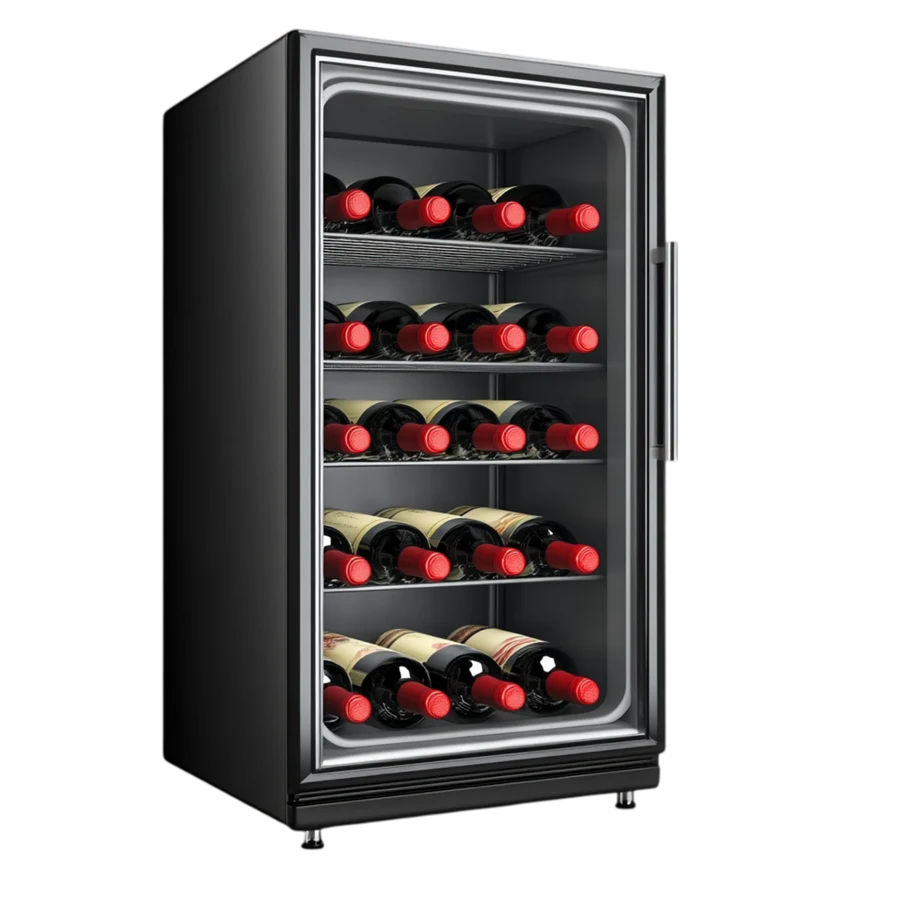
Wine-cooler illustration from ApplianceGo's existing image library. It does not identify the model discussed below or demonstrate a measured storage temperature.
A wine cooler may have room for a carton of milk or a container of leftovers, but available shelf space is not the deciding factor. Before using it for groceries, establish what the manufacturer permits and whether the appliance can maintain the conditions those foods require. A glass door, compressor or temperature display does not answer both questions.
If your kitchen refrigerator has failed, use suitable, reliably cold food storage while you check. Do not make perishable food the test load for an unfamiliar wine cabinet.
Read the permitted use before the temperature dial
The U.S. Miele KWT 6722 iS manual gives a clear example. Its safety section limits the appliance to wine storage. Its temperature section lists an adjustable range of 41 to 68 degrees Fahrenheit in both zones. Two independently controlled zones do not turn that model into a general-purpose food refrigerator.
That is a model-specific restriction, not a statement that every small cooling appliance has the same design. Check your own manual's intended-use section, available temperature range and any separate compartment instructions. A retailer's description or the words beverage center are not a substitute for that information. If the documentation is unclear, ask the manufacturer before storing foods that require refrigeration.
Wine settings and food-storage requirements are different
The FDA's refrigerator-thermometer guidance calls for refrigerator temperatures of 40 degrees Fahrenheit or below and recommends an appliance thermometer. In the Miele example, even the lowest available setting is above that limit. A wine cooler working exactly as designed can therefore still be the wrong place for refrigerated groceries.
Check what each food needs, too. FDA storage advice emphasizes package storage directions. A shelf-stable sealed drink and a product that needs refrigeration after opening are different cases; follow that product's label. Normal appearance or smell does not prove that a perishable item is safe.
Even a sufficiently low selectable number is not a complete approval. The appliance must be intended for the proposed use and actually maintain suitable storage conditions. Our guide to displays and thermometer readings explains why a requested setting and a measurement are not interchangeable.
Check the behavior after a power interruption
Do not assume your previous setting survives a loss of power. In GE's wine-chiller temperature guidance, the chiller described has a 40-to-65-degree Fahrenheit custom range but returns to a 55-degree red-wine setting after power loss. GE also describes a temperature difference between the upper and lower parts of that cabinet.
This does not establish how a different model restarts. It shows why the lowest advertised setting alone is insufficient evidence of suitability. Confirm your model's restart behavior and each compartment's purpose, rather than assuming one display represents every shelf or zone. Do not modify a thermostat, sensor or control to force a wine-only unit below its designed range.
A three-answer check before moving groceries
- Does the exact model's manual permit the kind of food storage you want? Record the model and the relevant manual section. If identification is difficult, use the appliance model-number guide; do not pull out a built-in unit just to search for a label.
- Can the intended compartment maintain the required temperature under the manual's operating conditions? Check the range and monitor actual conditions with a suitable appliance thermometer. Do not override a manufacturer restriction because of one cold reading.
- Does each product's label allow that storage, including after opening? Keep an unanswered item in appropriate food refrigeration while you clarify it.
Food already stored too warm needs a separate safety decision. The FDA's thermometer guidance says to discard food when you are unsure how long it has been at or above 40 degrees Fahrenheit. A later cold reading cannot establish its earlier storage history. Do not taste it to decide.
If a cabinet cannot maintain its own documented range, contact the manufacturer or a qualified service provider. Distinguish that performance problem from asking a correctly working wine-only appliance to do a different job. For ApplianceGo service requests, check your ZIP in the booking form; availability is determined by the ZIPs currently accepted there.
Editorial note: AI-assisted article prepared for ApplianceGo using the linked Miele, GE and FDA resources, checked October 21, 2026. The three-answer check is editorial guidance, not a technician inspection, a food-safety certification or approval of a particular installation.
