
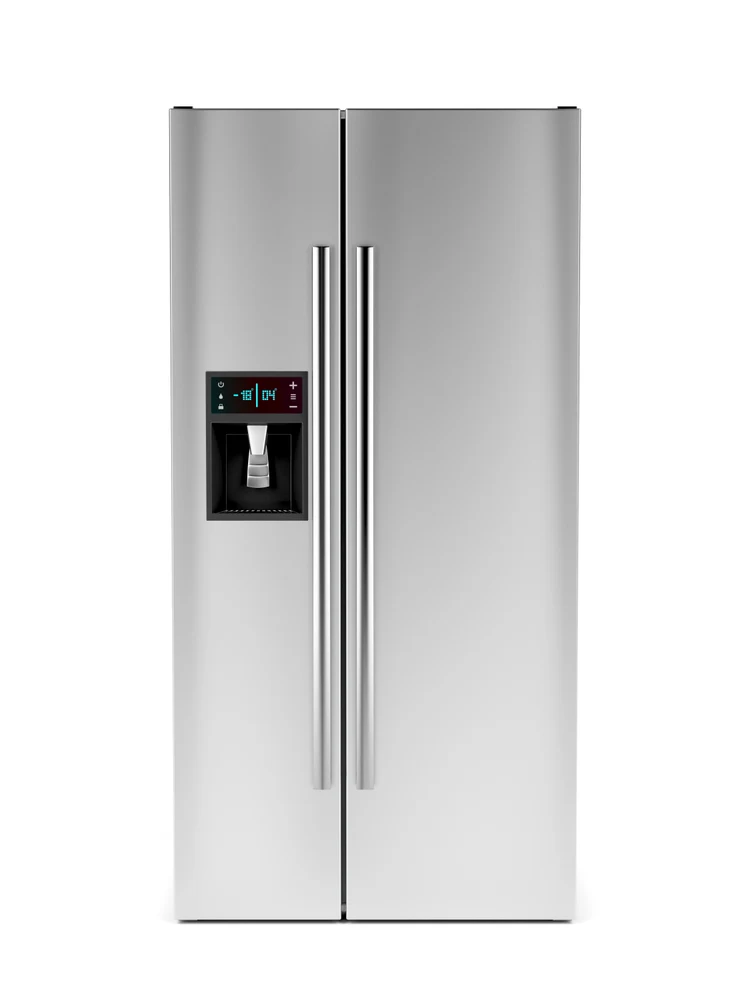
Illustration: a refrigerator with an external control panel. The pictured display is not a temperature test or a record of a customer repair.
What is the screen actually telling you?
A refrigerator display and a separate thermometer can show different numbers without measuring the same thing. Before deciding that either one is wrong, identify what each number represents. A selected temperature, a momentary air reading, and a measurement taken in chilled liquid are not interchangeable.
GE's explanation of set and actual temperatures says its electronic controls generally display the chosen setting. It also identifies older side-by-side models that can show both setting and actual temperature. The manual for your exact model determines which behavior applies; neither the brand name nor the appearance of the panel settles it.
Check the temperature unit and compartment, too. A freezer number is not the fresh-food temperature, and a Fahrenheit setting cannot be compared directly with a Celsius measurement. If you need the correct manual, start with the model number on an accessible appliance label.
Put food safety ahead of a comparison test
The FDA's refrigerator-thermometer guidance calls for refrigerator temperatures of 40°F or below and recommends a separate appliance thermometer. A reassuring control setting does not establish that food has been kept cold enough.
If cooling is failing, move still-safe perishables to reliable cold storage now. For uncertain warm exposure, follow the FDA's discard guidance, not a later cold reading. Do not taste food to judge safety.
The steps below are not permission to leave food in a warm refrigerator or a substitute for commercial food-safety procedures.
Keep three kinds of numbers separate
- Control setting: the temperature requested from the appliance, when the manual identifies the screen as a set-point display.
- Appliance-thermometer reading: a separate measurement used to monitor storage conditions, taken according to that thermometer's instructions.
- Manufacturer's performance check: a specified test method that may use a different location or measuring medium from routine monitoring.
For example, GE's internal-temperature measurement procedure explains that door openings and defrost affect air readings. Its performance check uses food or liquid already refrigerated for at least 24 hours, with placement depending on refrigerator design. It also allows 24 hours for stabilization after a setting change. Those conditions are part of that procedure, not a universal instruction to wait a day while food warms.
Routine monitoring and a controlled performance check answer different questions. Do not discard an appliance thermometer's warning simply because a different method produces a lower number. Equally, do not call the difference a sensor fault before checking how the measurements were made.
A short checklist before comparing readings
- Label the screen value. Is it a requested setting or an actual reading? Record the unit and compartment without changing controls just to make the numbers agree.
- Choose a suitable instrument. Use an appliance thermometer for storage monitoring. For a model-specific test, follow both the appliance and thermometer instructions. Do not immerse a thermometer that is not intended for liquid measurement.
- Keep the conditions identifiable. Note where and how the measurement was taken, whether the door had just been open, and any recent control change. Avoid repeatedly opening the door to watch the number.
- Report observations, not a guessed repair. A persistent mismatch is useful information, but it does not identify a failed sensor, control board, fan, or compressor by itself.
Consider this illustrative example: the screen shows a confirmed 37°F setting, while a correctly used appliance thermometer reads 39°F. That is not a two-degree calibration test, because the screen is displaying a request rather than a second measurement. It also cannot prove that every shelf or the previous night's food storage was safe. The point is to compare like with like, not explain away warming.
When to stop adjusting and request help
Ask the manufacturer or a qualified service provider for help when monitoring shows the refrigerator cannot maintain safe storage, when a model-specific check remains outside its stated range, or when you cannot establish a trustworthy reading. You do not need to complete a prolonged test before reporting a cooling concern.
Leave sensor access, electrical testing and sealed-system diagnosis to a technician. No panel removal, repeated power cycling or refrigerant work is needed to document a display disagreement. Send the setting, measured value, unit, location and method together so the distinction stays clear.
To request ApplianceGo service, check your ZIP in the booking form. Service coverage is determined by the ZIPs the booking system currently accepts.
Editorial note: AI-assisted article prepared for ApplianceGo from the manufacturer and FDA resources linked above, checked October 2, 2026. No technician inspection or customer case is represented.
