
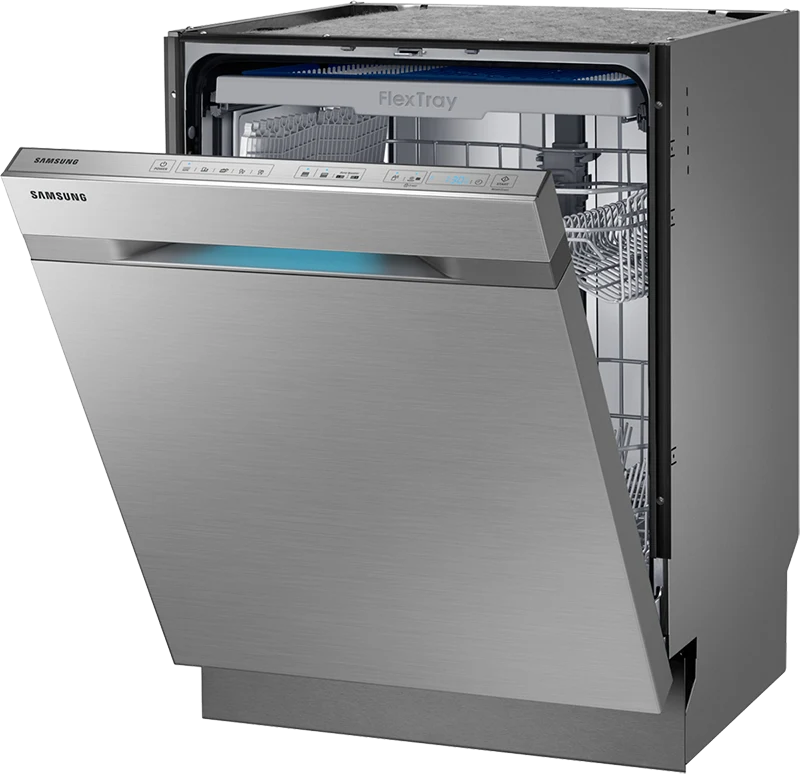
Illustrative dishwasher image from ApplianceGo’s existing image library. It does not show the rinse-aid dispenser; dispenser and control designs vary by model.
Rinse aid changes how water leaves dishes
Rinse aid is a wetting agent released during the rinse portion of a dishwasher cycle. GE explains that it helps water flow off dishware, which can reduce drying time, water spots and streaks. It is a finishing aid: it does not replace dishwasher detergent or turn a poorly cleaned load into a clean one.
The dispenser may have a refill window, a light, a small level gauge or another model-specific indicator. Some dishwashers also let you adjust how much rinse aid is dispensed. The control is not universal, so identify the exact model before changing it. Our model-number guide explains how to locate an accessible appliance label.
Read the result before changing the setting
Start with the symptom and the manual’s description of the dispenser setting. Wet dishes, water spots and streaks do not all call for the same change. Whirlpool says its adjustable setting changes the amount released in the final rinse and points owners to the model manual. A Bosch use-and-care manual gives one example: a higher setting adds more rinse aid and can reduce water spots and improve drying, while a lower setting adds less and reduces streaking. Those examples are not a shared control scale for every dishwasher.
- Dishes finish wet or show water spots: check that the cycle completed, the dispenser is not empty and the selected drying option matches the manual. If the manual permits, use its direction for a small increase.
- Streaks appear: check the manual’s advice for lowering the amount. Bosch’s example identifies reducing the setting as a way to reduce streaking.
- Food or detergent residue remains: treat that as a cleaning or cycle observation. Rinse aid supports water sheeting and drying; it does not remove the need for the correct detergent, loading and wash program.
Make one permitted adjustment at a time, then compare the next ordinary load using a similar cycle and loading pattern. Record the old setting and what changed. This makes the result easier to interpret than changing detergent, loading and several controls together.
Use the dispenser the way your model specifies
Follow the owner's manual for opening, filling and closing the reservoir. Use only rinse aid intended for household dishwashers; the Bosch manual warns that spilled rinse aid can create excessive foam and instructs users to remove spills. Avoid pouring it into the detergent cup or directly into the tub unless your model’s instructions explicitly say to do so.
Do not copy a button sequence, dial direction, fill level or refill interval from a different dishwasher. GE’s support guidance describes several different indicator designs, including a window, a low-level light and a dipstick. A clear window is not necessarily an illuminated warning light. The model manual is the reference for what your indicator means.
Keep rinse aid separate from salt and detergent
Rinse aid, dishwasher salt and detergent have different roles and, where fitted, different reservoirs. Rinse aid helps water drain from surfaces; salt is used by a water-softening system on equipped models; detergent cleans the load. See our guide to whether a dishwasher needs salt for the model-specific softener question. If plastic items remain wet, that can also reflect how their surfaces retain droplets; our plastic-drying guide covers that separate issue.
If the dispenser will not close, leaks, or the indicator behavior does not match the manual, stop adjusting it and contact the manufacturer or a qualified service provider. Include the model, the exact indicator, the current setting and the load result. For ApplianceGo service, check your ZIP in the booking form; availability follows the ZIPs currently accepted there.
Editorial note: This AI-assisted guide was prepared for ApplianceGo using the linked Whirlpool, GE Appliances and Bosch manufacturer resources, checked November 19, 2026. It is general guidance, not a technician inspection or diagnosis of a particular dishwasher.
