
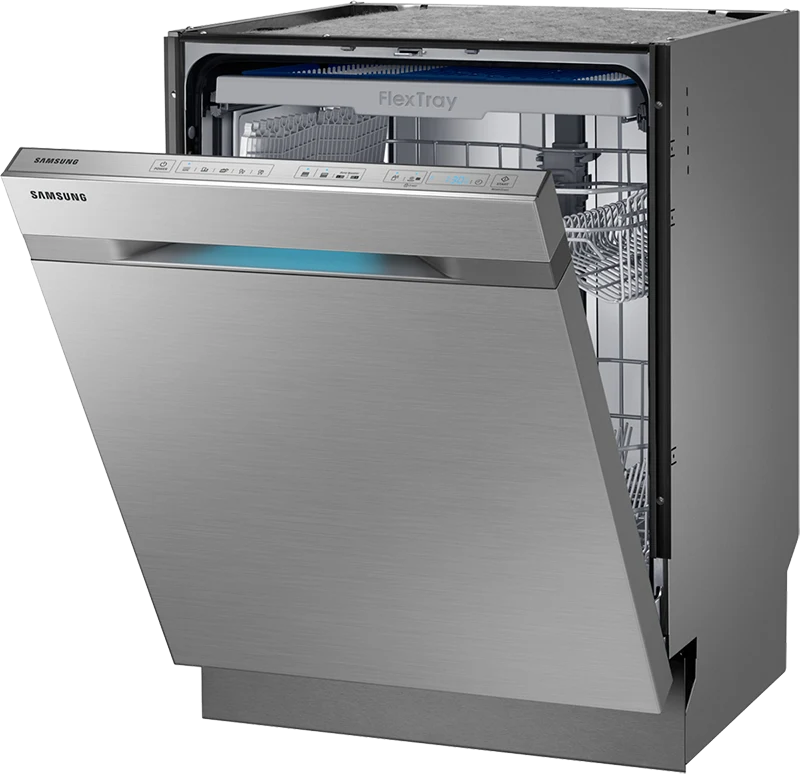
Dishwasher illustration from ApplianceGo's existing image library. It does not identify a salt reservoir or establish that the pictured model has a water softener.
Start with the appliance, not the shopping list
A bag of dishwasher salt is not an extra detergent for every machine. Before buying it or opening a cap inside the tub, check whether your exact model has a built-in water softener that uses salt. Whirlpool's water-softener guidance explicitly notes that not all dishwashers have a salt reservoir. On equipped machines, the salt helps regenerate the softener's ion-exchange resin.
Look for the water-softener section and the labeled component diagram in the owner's manual. If the manual says your model has no such system, do not add salt to a detergent cup, filter opening or the tub instead. If the feature is unclear, ask the manufacturer with the complete model number before adding anything. A cap's appearance is not enough to identify its purpose.
Match the setting to the water, not the neighborhood
For an equipped model, the next question is whether its instructions call for salt at your water hardness. Bosch's U.S. salt guide recommends obtaining the hardness from a test strip or water supplier and using the appliance manual's hardness table to select the setting. It also warns against substituting table salt for dishwasher salt.
Keep the hardness value and its unit together; do not copy a setting number from another model. If your home already treats the incoming water, ask which reading represents the water actually supplied to the dishwasher. A city name or spots on a glass should not replace the information required by your manual.
The useful outcome is specific: either the model does not use salt, the manual does not require it at the confirmed hardness, or the documented softener setting and refill instructions apply. An unknown model or hardness stays an unanswered question, not a reason to pour some in and see.
Keep salt separate from detergent and rinse aid
Use only dishwasher-softener salt permitted by the appliance instructions, in the identified salt reservoir. Whirlpool warns that other salts may contain additives that damage the softener, and that detergent or other chemicals put into this container can also harm it. The detergent compartment and rinse-aid dispenser are not alternative salt-fill points.
Follow the exact model's filling sequence, cap closure and spilled-salt instructions. First filling and later refills may differ; do not borrow another machine's water quantity, salt capacity or cleanup cycle. This guide deliberately gives no universal refill amount or schedule.
If detergent has already gone into the salt reservoir, do not start a wash to flush it out. Miele's U.S. guidance for that mistake says not to start the appliance because the detergent will damage the softener, and directs the owner to Miele Service. For another brand, stop and obtain its instructions. Keep the product packaging and explain what went where; do not attempt to neutralize it with another chemical.
Do not use a refill light as a mixing instruction
An all-in-one tablet does not settle every model's refill requirements. Miele's salt and rinse-aid indicator guidance discusses combination tablets separately from the refill indicators and notes that a salt light can remain on after filling while salt dissolves. An illuminated light immediately afterward is therefore not, by itself, proof that you need to add more.
Check your own manual's combination-detergent settings and indicator explanation. Do not disable a reminder merely to remove it, repeatedly top up a full reservoir or assume a light means a failed sensor. If the behavior does not match the instructions, record the exact message and when it appeared before requesting support.
Keep a short refill record
- Full model number and the manual page identifying the softener, if fitted.
- Water-hardness value, unit and source, plus the model-specific setting.
- Product name, reservoir used and whether this was an initial fill or a refill.
- Exact indicator or message before and after the refill, without running extra test cycles.
Use our model-number guide if you need help finding accessible identification. Do not pull a built-in dishwasher out or remove panels for this check. A leak, burning smell or electrical trip is a separate reason to stop using the machine, not a salt-maintenance task.
For ApplianceGo repair availability, check your ZIP in the booking form. Coverage is determined by the ZIPs currently accepted there.
Editorial note: AI-assisted guide prepared for ApplianceGo from the linked Whirlpool, Bosch and Miele resources, checked October 19, 2026. No technician inspection, customer case or product endorsement is represented.
