
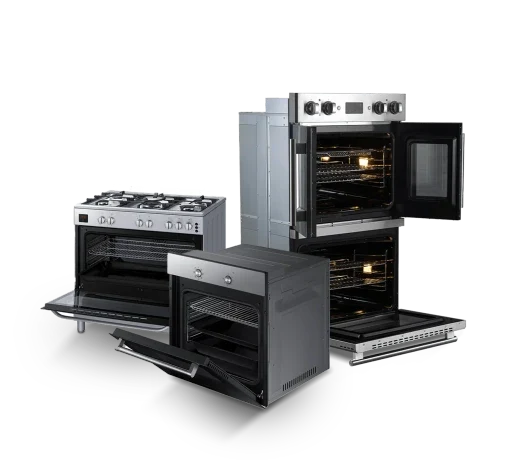
Illustration: household cooking appliances from the site's existing image library. This is not a fan diagram or a photograph of a repair; fan arrangements differ by model.
The cooking cycle can end before cooling does
You finish baking, switch the oven off, and still hear moving air. On a model equipped with an automatic cooling fan, that can be part of normal operation rather than a cooking cycle that has refused to stop.
The important distinction is between a fan continuing to cool the appliance and an oven that is still heating when it should not be. This guide addresses ordinary fan noise after cooking, not smoke, a burning electrical smell, a tripped breaker or suspected uncontrolled heating. Those concerns need prompt help, not a wait-and-listen test.
Two fans can have different jobs
A convection fan circulates air inside the cooking compartment. A cooling fan, where fitted, helps protect components and controls from excess heat. GE's explanation of oven fan operation distinguishes the two and describes a thermostat-controlled cooling fan that can continue after the oven is switched off.
That does not mean every range has this feature. The same GE page specifically excludes the freestanding gas and dual-fuel ranges it describes from its cooling-fan explanation. Your own model's manual, not the presence of a fan sound or the brand name alone, establishes which system is installed.
Do not open a cover to identify the fan or reach into a vent. If you cannot identify the model from paperwork, our appliance label guide explains how to check accessible labels without pulling out an installed appliance. Wait until it is safe and cool before looking around a door opening.
There is no useful universal countdown
Whirlpool's wall-oven fan guidance says cooling-fan run time depends on factors including how long the oven operated, its temperature setting and the surrounding kitchen. A brief bake and a long, hotter cooking session are therefore not equivalent comparisons.
Do not treat an arbitrary number of minutes from another model's advice as your oven's failure threshold. Check the operating instructions for your exact appliance. Equally, the fact that cooling can continue after cooking is not permission to dismiss a new noise, an error message or heating that does not stop.
Choose the next step from the circumstances
Familiar airflow after a completed cycle
If the cooking mode has ended, there are no warning signs, and the behavior matches your manual, allow the normal cooling sequence to finish. Do not cut power merely to silence an expected cooling fan, cover a vent to reduce the sound, or start another cycle to test it.
Follow your model's door instructions rather than propping the door open to hurry cooling. A general fan article cannot establish that the oven surfaces are safe to touch.
A changed or unexplained pattern
Ask the manufacturer or a qualified service provider when the behavior differs from the manual or from comparable previous use. Examples include a new scraping or grinding sound, a recurring displayed fault, or fan operation with no recent oven use and no explanation in the manual. These are reasons to seek an assessment, not proof that a particular fan, sensor or control board needs replacement.
A safety warning
If the oven appears to keep heating after cancellation, stop routine troubleshooting and seek urgent assistance. Do not run self-clean, keep resetting controls or touch an element to find out whether it is still powered. If there is immediate danger, leave and call emergency services from a safe place.
A suspected gas leak takes priority over every check above. Con Edison's gas-safety guidance says to leave the area and call 911 or the gas utility once safe. Do not operate the oven, electrical switches or a phone in the suspected leak area, and do not try to locate the leak yourself.
Describe what continued, not just "it stayed on"
For a non-emergency service question, these four details separate a cooling-noise concern from an unresolved cooking or control problem:
Model and mode: the exact appliance model and the cooking mode used before the sound began.
End of cooking: when you ended that mode and what the display showed afterward.
Sound: whether you heard steady airflow, scraping, grinding or another distinct sound.
Outcome: whether it stopped on its own, and any error already displayed.
Report only what you observed; do not reproduce a fault for a recording. A qualified assessment can then start with the right symptom instead of an assumed failed part.
To request ApplianceGo service, check your ZIP in the booking form. Coverage is determined by the ZIPs the system currently accepts.
Editorial note: this AI-assisted article was prepared for ApplianceGo using the manufacturer and utility resources linked above, checked October 4, 2026. It is not a technician inspection or a customer repair account.
