
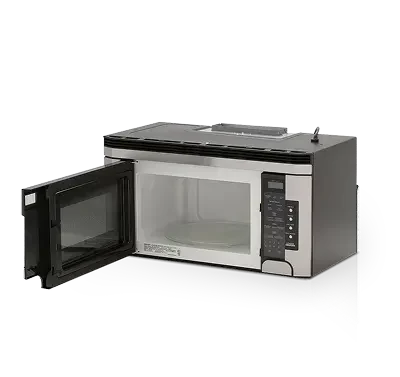
Illustration: an open microwave from the site's existing image library, not a customer repair or an instruction to operate with the door open.
A stationary tray does not identify a broken motor
The display counts down, but the glass tray stays still. Before treating that as a failed part, establish whether you selected cooking or just the kitchen timer, whether your model allows rotation to be switched off, and whether the removable tray is fitted correctly.
Safety takes priority over those checks. The FDA's microwave guidance says not to use an oven with a door that is damaged or does not close firmly, and to stop using one that continues operating with the door open. Contact the manufacturer about those conditions. Do not hold, tape or bypass a latch to investigate.
Read the controls before changing them
GE's turntable troubleshooting page makes two distinctions worth checking in your own manual. A timer function is different from a cooking function. Also, some microwaves have a turntable on/off control that may have been switched off unintentionally.
If only the kitchen timer was selected: a stationary tray is not evidence of a rotation fault. Confirm the control labels without starting an empty cooking cycle.
If turntable-off was selected: follow the model's instructions to restore normal rotation. Do not assume that every microwave has this option, or disable it to work around an unexplained failure.
Direction is a separate issue. Whirlpool's countertop-microwave guidance says rotation can start in either direction. Turning the opposite way on a later cycle is not the same observation as never turning at all. Check your model's instructions before calling a direction change a defect.
Inspect only the cool, user-removable tray
End the cycle, let the tray cool, and follow the manual's cleaning and power-disconnection precautions. Unplug only where the plug is dry and safely accessible; do not move a built-in or over-the-range unit to reach it.
GE identifies an upside-down or poorly seated tray and food beneath the support-ring wheels as possible obstacles. Compare the tray and support with your manual's diagram, especially if they were recently removed for cleaning. Remove only pieces the manual identifies as user-removable.
Whirlpool likewise calls for the correct orientation and secure seating on the support, and warns against operating without the turntable installed. Do not substitute a similar-looking plate, force a center fitting or reach below the cavity floor. If a piece is damaged or will not sit correctly, ask the manufacturer which replacement fits your exact model.
Keep cleaning within the owner's instructions. The FDA recommends water and mild detergent for the cavity and warns against abrasive pads or steel wool. This is not permission to remove an interior cover or dismantle the drive mechanism.
Make the service note describe the actual problem
If rotation remains unexplained after the permitted checks, arrange an assessment instead of repeatedly restarting the microwave. You do not need to reproduce a fault to provide useful information. Record these details from what already happened:
Program and display: the selected function, any turntable-off indication, and the exact message already shown.
Tray behavior: completely still, moving in the opposite direction, or catching with a sound. Keep those observations separate.
Recent change: whether the issue began after cleaning, moving the removable tray, or fitting a replacement accessory. Do not assume the timing proves a cause.
Include the model number from paperwork or an accessible label. The appliance identification guide explains how to collect it without removing an installed unit.
Do not run an empty microwave as a test, keep using it through sparks or a burning smell, or remove its outer casing, even when unplugged. Internal motor, wiring and door-safety repairs belong to qualified service personnel. No observation in this guide establishes that food was heated safely.
For an ApplianceGo request, check your ZIP in the booking form. Service coverage is limited to the ZIPs it currently accepts.
Editorial note: this AI-assisted guide was prepared for ApplianceGo from the manufacturer and FDA resources linked above, checked October 6, 2026. It is not a technician inspection or a report of a customer repair.
