
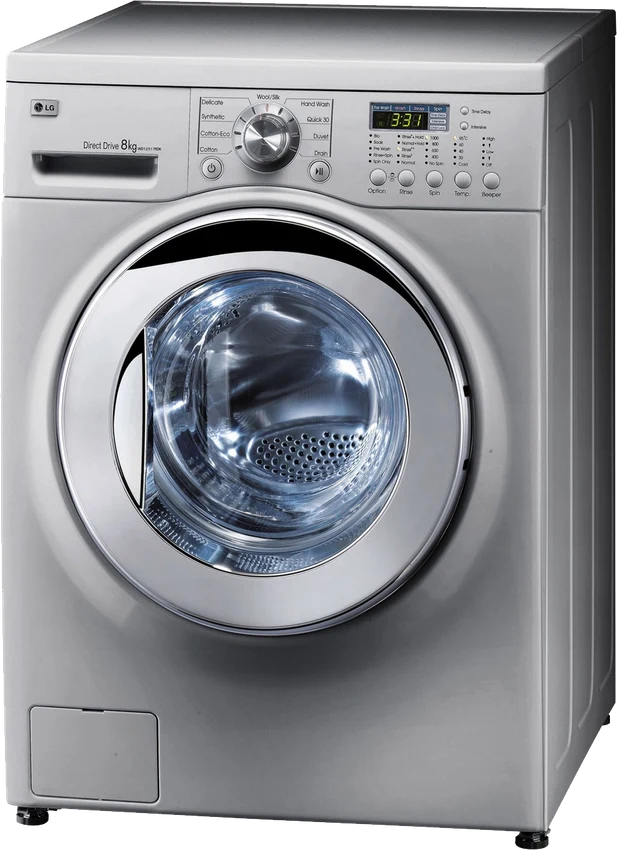
Illustration: a front-load washer from the site's existing image library. It does not show a running wash cycle or a recommended water level.
A low water line is not the same as no water
You start a front-load wash and cannot see the deep pool you expected behind the door. That view alone does not establish a filling fault. These machines do not need to submerge the whole load to wash it.
LG's explanation of low drum water levels describes laundry being lifted and dropped through water as the drum turns. Partial filling supports that tumbling action, and load sensing adjusts the amount of water. LG also cautions that its general guide may differ from your particular model.
The useful question is therefore not just how high the water looks. Is the washer progressing through its cycle, has it stopped with a message, or did a completed wash leave a cleaning problem? Those observations lead to different next steps. This guide concerns front-load washers; it is not a water-level test for every washer design.
Separate appearance, a stopped cycle and poor results
Only the appearance seems unusual: if the machine has been completing washes normally and the results are satisfactory, a low visible water line by itself is not a reason to top it up. Check the operating description for your model. Normal-looking operation is not proof that every component is working, but there is no universal door-window fill mark to use as a diagnosis.
The cycle will not proceed or shows a fill message: treat this as a separate symptom. GE's front-load no-fill guidance includes an accidentally paused cycle and hot or cold water supplies being turned off among its checks. Read the control display and note any recent installation or water-supply work. Check your own manual before using a resume control; do not assume a code has the same meaning across brands.
Keep any supply check to what is safely visible and accessible. Do not pull a stacked or built-in machine forward, disconnect hoses, remove inlet screens or force a valve to investigate. If the washer still cannot fill or repeatedly stops, arrange model-specific support rather than running reset cycles to make the message disappear.
The wash finishes but clothes remain dirty or have residue: that outcome deserves attention, but it does not identify low water as the cause. Whirlpool's water-use guidance explains that front-loaders use low water levels and recommends HE detergent for that design. It also emphasizes matching the cycle to the load. Compare the selected cycle, loading instructions and detergent directions with your model's manual. Persistent poor results are useful to report even when no error appears.
Do not turn a visual check into a repair
Do not pour extra water into the drawer or drum just to reach a line on the glass. Use only the water or rinse options documented for your machine. Do not adjust a pressure sensor, enter service settings, bypass the door lock or force the door open.
A visible leak or an electrical concern is not explained away by normal low-water operation. Stop using the washer and seek qualified help. Keep away from wet plugs or outlets; do not reach through water to unplug it. There is no need to run another cycle solely to reproduce a fault for a photograph.
A short note makes a service request more useful
Record the model, selected cycle and the stage at which you noticed the issue. Say which problem you actually observed: little visible water, a stopped cycle, or poor results after completion. Include the exact displayed message, if any, and recent installation or supply changes. Report what happened without naming a failed valve or sensor.
Use paperwork or a safely accessible label; the appliance model-number guide can help. For ApplianceGo service, check your ZIP in the booking form. Service coverage is limited to the ZIPs currently accepted there.
Editorial note: this AI-assisted article was prepared for ApplianceGo using the LG, GE and Whirlpool pages linked above, checked October 8, 2026. It does not represent a technician inspection or a customer repair case.
