
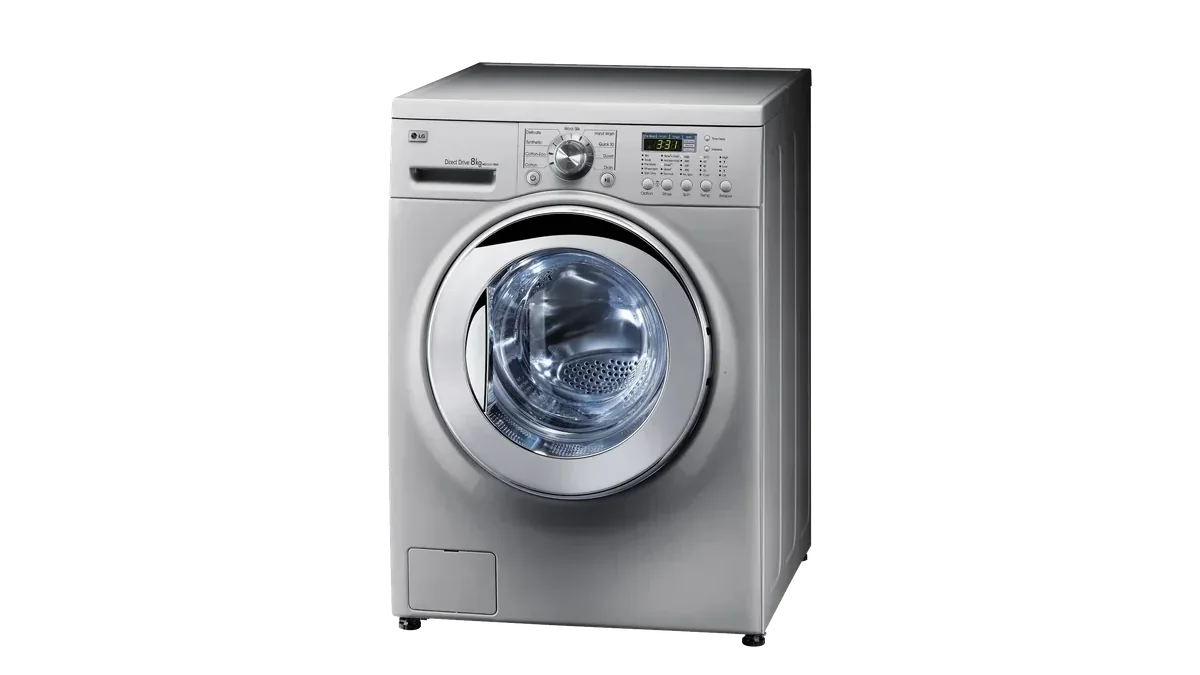
Front-load washer illustration from ApplianceGo's existing image library. The pictured controls do not demonstrate an unlocking procedure or a fault.
Check what happened after the wash
The laundry has stopped moving, but the door will not open. Before assuming the latch has failed, check whether the display actually shows completion, whether a post-wash option is active, and whether the washer is still managing water or heat. These observations lead to different instructions.
This guide helps you choose the right section of your model's manual. It is not an emergency-release procedure. Do not pull harder on the handle, insert a tool around the latch or remove a panel to reach it.
Look for a post-wash option before starting another cycle
Some washers intentionally keep laundry behind a locked door after the main wash. Whirlpool's door-unlock guidance describes TumbleFresh as periodic tumbling with the door remaining locked while the option is active. The same page discusses Fresh Hold on models equipped with it.
If your display shows an extra-care option, look up how your model ends that option and releases the door. Do not start a new wash just to clear the message. A familiar-sounding feature name on another brand is not enough to choose a button sequence.
A pause, a drained drum and a released lock are separate events
Whirlpool's front-load door guidance explains that high water level, high water temperature and drum movement can delay release after a pause request. Its timing and button instructions describe particular control arrangements, not a countdown that every washer follows.
LG's U.S. explanation likewise identifies heat, retained water and spinning as reasons for the safety lock to stay engaged. LG warns that hot water or steam can burn and that forcing the door can damage it.
- Water is visible: do not treat the lock as the only problem. Find the model's retained-water instructions. If they specify a normal panel-operated drain program and there is no leak or other hazard, follow those instructions. If it fails to drain, stop repeating cycles and ask for help.
- A hot or steam program just ended: allow the documented cooling and release sequence to finish. Do not touch the glass to test its temperature or use another model's wait time as proof that opening is safe.
- No water is visible: report that observation, not that the machine is definitely empty or its lock is defective. An outside view does not establish every condition inside.
Keep emergency drain hoses, pump-filter caps and manual latch releases out of this basic check. Those are not interchangeable unlocking shortcuts. If access would require them, consult the manufacturer for your exact model or arrange qualified help.
Do not assume Child Lock affects only the buttons
Samsung's U.S. locked-door guidance says Child Lock also holds the door closed on some models, including front loaders. It separately notes that the mechanism can take a short time to release after the cycle finishes. A lock icon therefore needs its model-specific meaning, not a universal press-and-hold trick.
Check the manual's Child Lock or Control Lock section if that setting is indicated. Turning off a user setting is not permission to override a door that remains physically locked. If the indicated setting is already off and the documented release sequence has finished, contact support instead of cycling through unrelated button combinations.
Give support a sequence, not a guessed part failure
Before calling, complete this short account using only what you can safely observe:
Model: ___. Program and optional post-wash setting: ___. At ___ the display showed ___; I had waited / paused / cancelled. Water is visible / not visible / unclear. The drum is moving / stopped / unclear. The lock indication or error reads ___. I followed this manual instruction: ___, and the result was ___.
If the model label is behind the locked door, use purchase paperwork or an existing photo; do not force access. The model-number guide explains safe identification. There is no need to run another load to complete the account.
A door that remains locked after the manual's applicable checks, recurring faults, or a damaged handle calls for manufacturer or qualified service support. If there is smoke, a burning smell or leaking water near electrical connections, stop routine troubleshooting and seek urgent help from a safe location. Do not reach through water to unplug the washer.
For ApplianceGo service, check your ZIP in the booking form. Availability is limited to the ZIPs currently accepted there.
Editorial note: AI-assisted article prepared for ApplianceGo from the linked Whirlpool, LG and Samsung resources, checked October 20, 2026. The observation account is editorial guidance, not a technician inspection or a model-specific repair procedure.
