
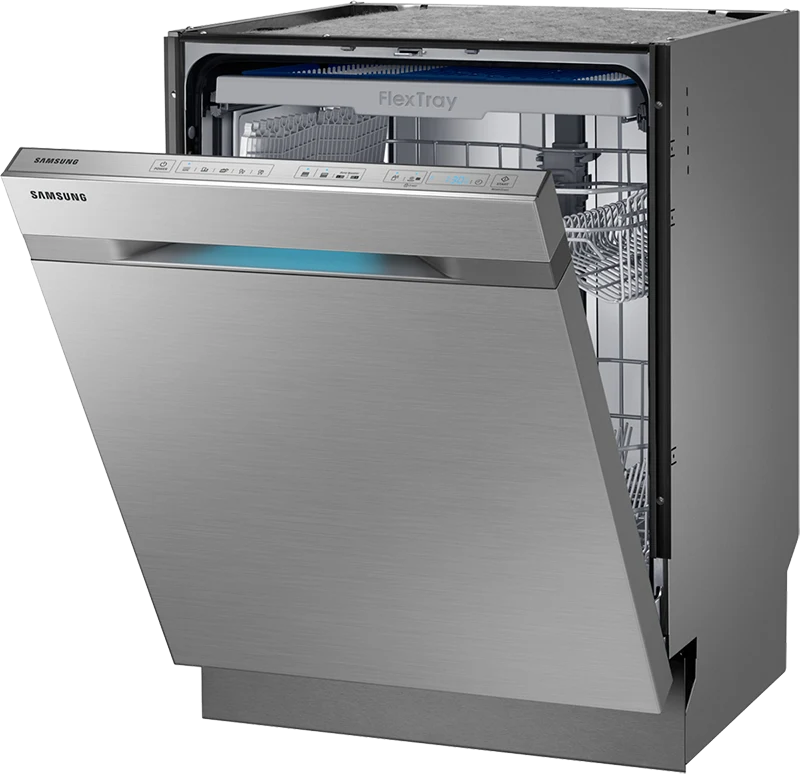
Illustration: a dishwasher from the site's existing image library, not a customer repair or a guide to the dispenser layout on your model.
Check whether the wash actually finished
A tablet left in the dishwasher's detergent cup does not, by itself, mean the dispenser needs replacing. Before cleaning away the evidence, note whether the lid is closed, partly open or open with detergent inside. Also check what the display says: a completed wash and a canceled or interrupted cycle are not equivalent results.
Whirlpool's dispenser-residue guidance identifies an unfinished cycle as one reason detergent may not have dissolved. If the machine stopped with a message, record it and consult the matching manual. Do not repeatedly reset it or add another tablet on top of the remaining detergent.
Give the dispenser lid room to work
Once the cycle has ended and the interior is safe to handle, look at the loading arrangement before unloading everything. A pan handle or tall item near the cup may be more informative than a photograph of the empty machine.
GE's detergent-cup guidance describes dishes and pot handles obstructing the cover, as well as a tablet positioned so that it binds the lid. Follow your model's loading diagram and detergent instructions. Reposition an obvious movable obstruction; do not bend the dispenser, pry its cover or force a tablet into a compartment that will not close normally.
Do not judge every lid by how far it opens. GE says its flip-open cup can normally meet the upper rack at about a 45-degree angle while water reaches the detergent. That is a specific design example, not a required angle for another dishwasher. A lid resting against a rack is therefore not automatically a jammed lid; identify the dispenser type in your own manual before trying to change its travel.
Check the detergent and accessible residue
Whirlpool also explains that aged detergent exposed to air can clump, dissolve poorly and stick to the door. Keep detergent fresh and follow its package's storage directions, with the container closed in a cool, dry place. Use only detergent intended for automatic dishwashers, in the amount and location specified for your appliance.
For accessible old residue, use the dispenser-cleaning method in the owner's manual. Keep this to routine surface care after the machine has stopped and cooled; leave covers, springs and latches assembled. Do not cut open a pod, scrape the mechanism with a tool or substitute hand dishwashing liquid.
Moving a tablet to the bottom of the tub is not a universal workaround. Whirlpool's guidance places premeasured detergent in the main dispenser compartment with the lid closed. Follow your own model's instructions rather than bypassing a dispenser that repeatedly fails to release.
An open cup can still leave a problem to investigate
An open lid with detergent remaining is a different observation from a closed lid, but it still does not identify a failed part. GE's guidance on detergent stuck in the cup lists water not reaching the cup properly and water temperature being too low as possible explanations. Residue alone cannot tell you whether a heater, pump or control needs repair.
Use the manual for model-specific water-supply and cleaning requirements. Do not raise the household water-heater setting to chase an undissolved tablet, touch a heater to test it, defeat the door latch or open a running dishwasher to watch the spray. Internal testing belongs to qualified service personnel.
If the problem returns after appropriate loading and detergent checks, request help with a short description: the selected program, whether it finished, the lid position and where the detergent remained. Include an existing error message and a photo of the loading arrangement if you already have one. No extra fault-reproduction cycle is needed. Stop using the machine if it leaks, smells burnt or trips a breaker.
The model-number guide helps identify the correct manual without moving a built-in appliance. To arrange ApplianceGo service, check your ZIP in the booking form; coverage is limited to the ZIPs currently accepted there.
Editorial note: AI-assisted article prepared for ApplianceGo from the linked GE and Whirlpool support pages, checked October 9, 2026. No technician inspection or customer repair case is represented.
